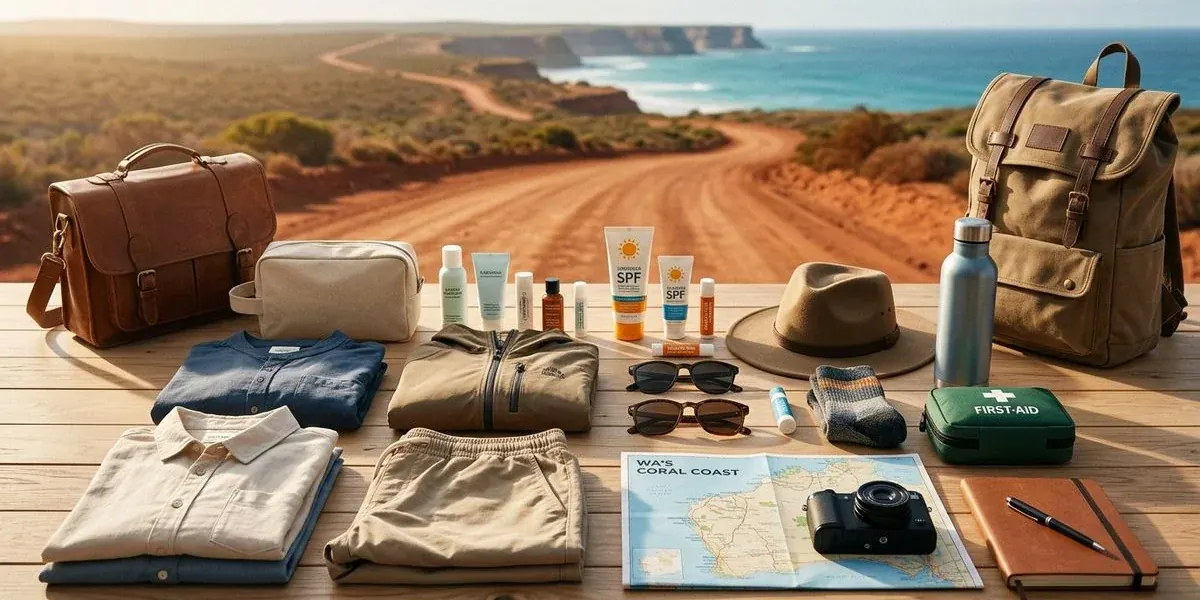
WA Road Trip Packing List: What to Bring in a 4WD Camper
What to pack for a WA road trip in a 4WD camper: what our campers include, what to bring, and what to wear in the South West and on the Coral Coast.
Dorian Menard
Founder & Owner
You only need to pack personal items. Every vehicle we hire comes with bedding and linens, complete cooking equipment, a camp table and chairs, and a lithium battery with solar charging, and both Wanderers add an 85L fridge. Your luggage is mostly clothes, toiletries, medication and food. The rest of this list covers what to add, what to leave at home, and how the season changes what you wear in the South West and on the Coral Coast up to Kalbarri and Shark Bay.
If this is your first trip of this kind, read our beginner’s guide to overlanding in WA first, then come back to pack.
What Your 4WD Camper Already Includes
This table comes straight from the vehicle pages for our Perth 4WD campers. Our hire FAQ puts it in one line: complete cooking equipment, bedding and linens, USB charging points, lithium batteries, solar charging and convertible table setups are included at no extra cost, and you bring your personal items. The live Camplify listing for your dates is the final word, so check it before you buy anything to match.
| Item | OFFGRID Wanderer | OFFGRID Wanderer 2.0 | Bakkie and Bakkie 2.0 |
|---|---|---|---|
| Sleeping | Premium rooftop tent, 15cm mattress, bedding and linens | Large rooftop tent, queen inflatable mattress, microfibre bedding (duvet or blanket hire $25) | Premium rooftop tent, bedding and linens |
| Fridge | 85L upright fridge/freezer | 85L upright fridge with a dedicated freezer compartment | Check the Camplify listing |
| Cooking | Gas and induction-capable setup, utensils, crockery | Gas burner, induction stove, pod coffee machine, kettle, toaster, cookware, utensils, crockery | Complete cooking equipment and crockery |
| Table and chairs | Convertible camp table and chairs | Camp table and chairs | Camp table and chairs |
| Shade | 270-degree freestanding awning | 270-degree freestanding awning | Check the Camplify listing |
| Power | 300Ah lithium with solar, USB charging | 300Ah lithium, 200W solar panel, 3000W inverter, USB charging | High-capacity lithium with solar, USB charging |
| Water | 22L portable shower | 100L integrated water tank with camp shower | Check the Camplify listing |
| Internet | Starlink as a separate hire | Integrated Starlink (data plan fees apply) | Starlink as a separate hire |
| National park pass | Not included | Included | Check the Camplify listing |
For a plain-English look at what a hire rate should and should not cover, see our guide to 4WD camper hire costs in Perth.
Not listed on our vehicle pages: ask before you buy
These items are not on the vehicle pages, so do not assume they are on board:
- A torch or head torch for each adult
- A first aid kit
- A UHF radio
- Spare containers for drinking water
- Dish soap, tea towels and rubbish bags
Some may be on board. Ask when you book or at the pre-departure walkthrough, which covers camping equipment setup, rather than doubling up or going without.
Clothing: Pack for the Place and the Month
Western Australia is not one climate, and the gap between Margaret River and Kalbarri is bigger than most visitors expect. The table uses long-term monthly means from the Bureau of Meteorology (BoM), so any single day can run hotter or colder. It shows January (peak summer) and July (mid-winter), with the South West first.
| Place (BoM station) | January mean max / min | July mean max / min | July rain |
|---|---|---|---|
| Perth Airport | 31.9°C / 17.1°C | 18.0°C / 8.1°C | 152.8 mm |
| Cape Leeuwin, south-west tip | 23.1°C / 17.0°C | 16.5°C / 11.4°C | 177.3 mm |
| Albany | 22.8°C / 15.3°C | 15.9°C / 8.3°C | 142.0 mm |
| Esperance | 26.2°C / 15.8°C | 17.3°C / 8.4°C | 96.0 mm |
| Geraldton Airport | 33.0°C / 19.2°C | 20.4°C / 9.2°C | 75.9 mm |
| Kalbarri | 33.3°C / 19.7°C | 21.9°C / 9.8°C | 71.1 mm |
| Shark Bay Airport | 34.2°C / 21.7°C | 22.8°C / 10.6°C | 27.8 mm |
Cape Leeuwin is the BoM station at the south-west tip, so it is only a guide for Margaret River and Busselton. Geraldton Airport has a short record (2011 to 2026), so treat its figures as a guide too.
What that means for your bag:
- South West in summer is mild. Cape Leeuwin averages a 23.1°C January maximum and Albany 22.8°C, against 31.9°C at Perth Airport. Pack for warm days, cool evenings and a windproof layer.
- The Coral Coast in summer is hot. Kalbarri’s January mean maximum is 33.3°C, and Geraldton Airport averages 10.3 days of 35°C or more in January. Shark Bay Airport recorded 49.2°C on 20 January 2026, the hottest day anywhere in WA that summer.
- South West winters are wet. Cape Leeuwin averages 177.3 mm of rain in July, and Perth Airport 152.8 mm. Pack a proper waterproof jacket, not a light shell.
- Tent nights get cold in winter. July mean minimums sit between 8°C and 9°C at Perth, Albany and Esperance. DBCA’s Lucky Bay page says nights can be cold from June to September.
Warm Weather Gear
- Long-sleeve sun shirts that cover your arms and neck, in a light, quick-drying fabric
- Wide-brim hat and sunglasses
- Shorts, plus one pair of lightweight long trousers for walks through scrub
- Closed shoes for walking and thongs or sandals for shower blocks
- Swimwear and a quick-dry towel
- A light rain jacket that doubles as a windbreaker
Cool Weather Additions
- A fleece or puffer jacket for evenings
- Thermal base layers to sleep in
- A beanie and warm socks
- A waterproof jacket and a spare pair of shoes for the wetter South West months
Cotton is a poor choice when you expect to get wet, because it holds moisture and stays cold. Synthetic and merino layers dry faster. If you run cold, note that the Wanderer 2.0 listing offers duvet or blanket hire for $25.
Sun protection is not only a summer job. Cancer Council recommends SPF50 or SPF50+, broad-spectrum, water-resistant sunscreen whenever the UV level is 3 or above, used alongside clothing, a hat, shade and sunglasses.
Toiletries, Medication and Bites
- Sunscreen and lip balm as above
- Insect repellent. WA Health says to use a repellent containing DEET, picaridin or oil of lemon eucalyptus. It warns that eucalyptus-based essential oil products are not the same as oil of lemon eucalyptus and will not generally protect you. Follow the label on whichever product you buy.
- Prescription medicines in their original packaging, with a few days of buffer in case your plans change
- A small first aid kit, unless you have confirmed one is on board
- Wipes and a quick-dry towel. Hot water in campground showers is not always guaranteed, and DBCA says so on the Lucky Bay page.
Why the repellent matters: Ross River and Barmah Forest viruses are the two most common mosquito-borne viruses in WA, and there is no vaccine or specific cure. The protection is not being bitten.
Food and Water
Water
Water is the item that trips up the most trips, so plan it before you plan the food.
- Drinking only. The NHMRC adequate intake of fluids is 2.6 litres a day for adult men and 2.1 litres for adult women. Two adults over four nights need about 19 litres between them for drinking alone (4.7 litres a day, times four). Cooking, washing up and hot days come on top.
- National parks often have none. DBCA lists “drinking water is not provided” at Lucky Bay, and says drinking water is not available in Kalbarri National Park.
- Walking uses more. For the Loop Trail in Kalbarri, DBCA says to carry and drink 3 to 4 litres of water per person per day. It also says the trail is closed after 7am from November to March inclusive, so if you travel this summer, plan to walk it at first light or choose another time of year.
- What your vehicle carries. The Wanderer 2.0 has a 100L integrated tank with a camp shower. The original Wanderer lists a 22L portable shower, and the Bakkies list no tank. Carry your drinking water separately in containers either way.
Food
- Shop for staples in Perth. Rice, pasta, wraps, tinned fish, beans, long-life milk, oats and snacks all travel well. Restock fresh food in regional centres such as Busselton, Albany, Esperance and Geraldton.
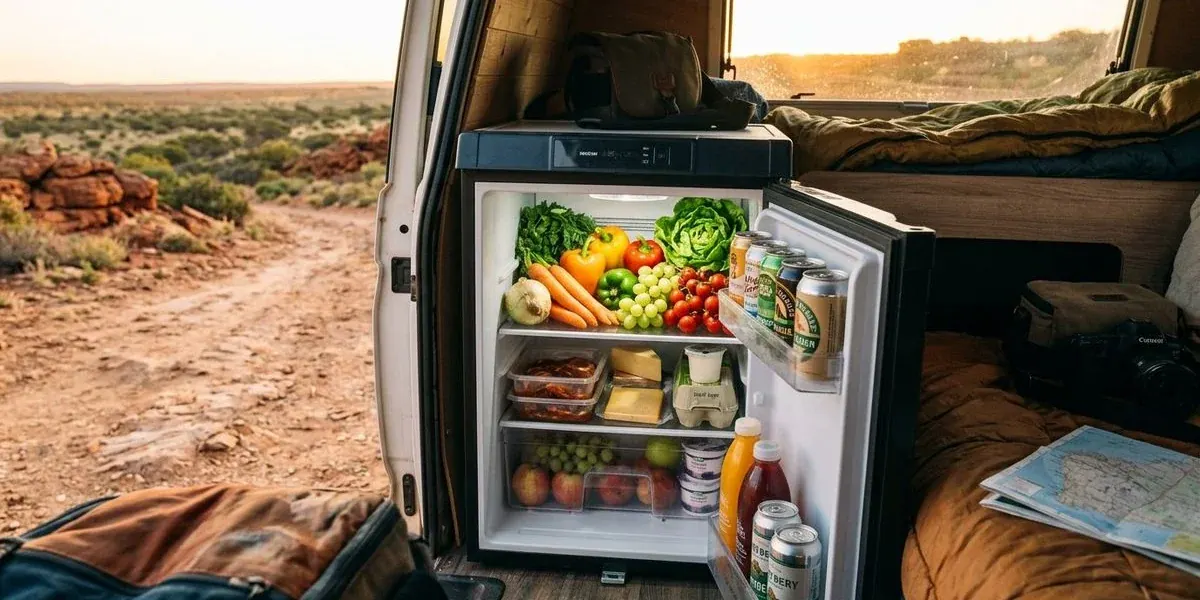
- Match the fridge to the days. Both Wanderers have an 85L upright fridge/freezer. Pack chilled and frozen food by the number of days between shops, not by the size of the fridge.
- Plan to cook without a fire. In south west parks, campfires are only allowed in the fireplaces provided, and not during bushfire season. Lucky Bay allows no campfires at any time. DBCA also says a gas barbecue needs an enclosed flame and all flammable material cleared five metres around it. Our vehicles list gas or induction cooking, so you do not need firewood.
Electronics, Navigation and Staying Connected
Mobile coverage thins out once you leave the larger towns, so sort your navigation before you leave Wi-Fi.
- Offline maps. Google Maps lets you download an area and navigate offline, as long as the whole route is inside the downloaded area. You will not get traffic information while offline.
- Road and emergency information. Main Roads WA suggests bookmarking its Travel Map and Emergency WA, and installing the Emergency+ app, because you can lose phone service in regional areas.
- Chargers and cables. USB charging points are listed on every vehicle. Bring your own cables and a power bank.
- Starlink. The Wanderer 2.0 has an integrated Starlink dish, and data plan fees apply. On the other vehicles, Starlink hire is an add-on, with one unlimited plan, a seven-day minimum and a price from $179 a week on our Starlink hire page. That page also notes performance may vary in heavily forested areas or deep valleys, which is worth knowing in the karri country of the South West.
- A head torch for hands-free cooking and walking to the shower block after dark.
Safety and Emergency Items
Breakdowns on our vehicles go through Camplify’s 24/7 roadside assistance, which is part of every hire. Personal safety is the part you pack.
- Tell someone your plan. DBCA’s camping advice is to tell a responsible person where you are going and when you expect to return.
- Carry a buffer. Main Roads WA suggests enough food and water to last 2 to 3 days past your intended travel time. For fuel planning, wildlife and fatigue, see our driving tips for regional WA roads.
- Consider a personal locator beacon (PLB) for long walks. DBCA suggests travelling with one on the Kalbarri Loop Trail. AMSA describes PLBs as personal beacons for bushwalkers, 4WD drivers and other adventurers on land.
- A copy of your plans on paper. Phones fail, and a printed itinerary helps whoever you have told.
What to Leave Behind
Overpacking costs you space every day of the trip.
- Hard suitcases. The Wanderer 2.0 lists two 1.3 metre deep-storage drawers plus storage boxes, and the Wanderer has canopy kitchen storage. Soft duffel bags flex into those spaces. Rigid cases do not.
- Anything we already supply. Bedding, cookware, crockery, a table and chairs are on the vehicle. Check the table above before you buy duplicates.
- Heavy 240V appliances. Only the Wanderer 2.0 lists a 3000W inverter for high-draw appliances. The other vehicles do not list one, so ask before you pack a hairdryer or similar.
- Excess towels and heavy books. One quick-dry towel each and an e-reader go a long way.
Packing Smart
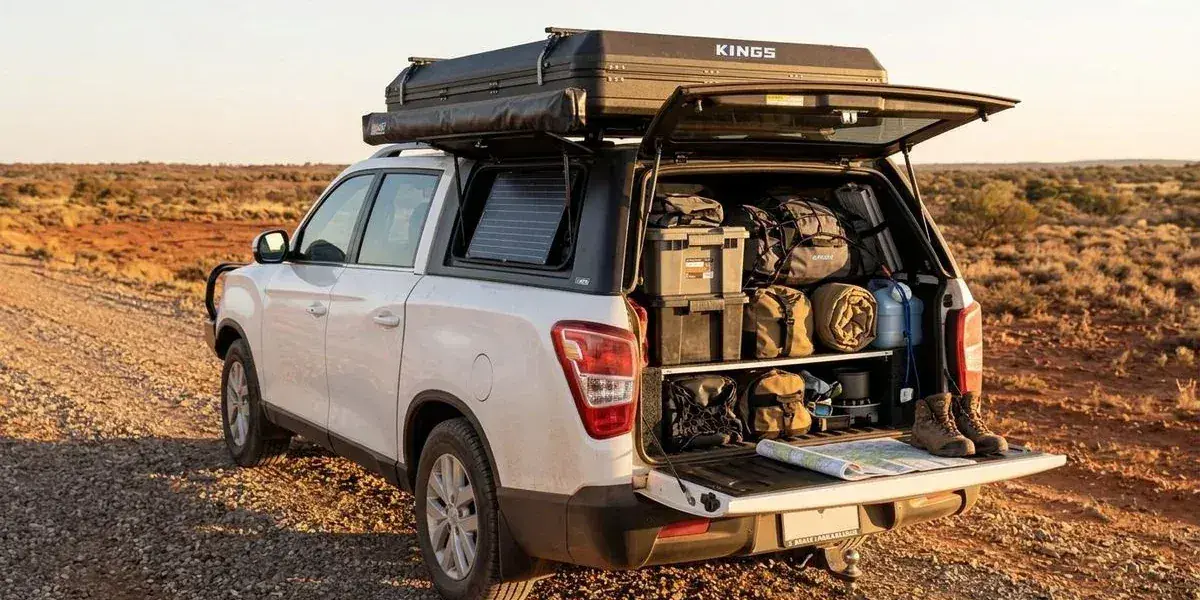
- Heavy items low and central. Water containers, tins and tools should sit low and toward the middle of the vehicle, not high or at the rear.
- Group by use. Packing cubes for clothes, a box for dry food, and a “daily” bag with sunscreen, snacks and a camera within reach.
- Pack a day early. Put everything out, check it against this list, and cut what you do not need.
What Catches People Out
- Packing for one climate. A bag for Perth in January is wrong for Albany in July, and the other way round. Use the BoM table above for your route and month.
- Assuming a national park has water. Several of the parks on our routes provide none.
- Doubling up on kit we supply. Check the table before you buy.
- Arriving without a full licence. The minimum hirer age is 24, and all hirers must hold a valid full driver’s licence.
- Returning the vehicle dirty. Our insurance and support page lists a $100 to $150 cleaning fee for an uncleaned vehicle and $250 for red dust contamination. A small brush and wipes in your kit helps.
- Not budgeting kilometres. The 200 km per day allowance is averaged over the whole trip. If you are planning Esperance, our Perth to Esperance road trip guide shows how far that trip really is.
Packing List FAQs
Do I need to bring bedding or sleeping bags?
No. Bedding and linens are included on every vehicle, and the Wanderer 2.0 uses microfibre bedding with a queen inflatable mattress. If you sleep cold, bring warm layers, or ask about the $25 duvet or blanket hire listed on the Wanderer 2.0 page.
How much drinking water should I carry?
Plan drinking water first at 2.6 litres a day for an adult man and 2.1 litres for an adult woman, then add cooking, washing up and heat. Several national parks on the route, including Lucky Bay and Kalbarri, provide no drinking water.
Can I bring a hairdryer or other 240V appliance?
Ask first. The Wanderer 2.0 lists a 3000W inverter for high-draw appliances. The other vehicles list USB charging, not a 240V supply, so a hairdryer may not run.
Do I need a national park pass?
The Wanderer 2.0 listing includes a WA national park pass, and the original Wanderer does not. Where a pass is not included, DBCA charges $17 per standard vehicle at Kalbarri National Park, and entry fees apply at over 30 WA parks. DBCA’s shop shows Holiday Passes from $30, which can work out cheaper over several parks.
What should I wear to sleep in a rooftop tent in winter?
Layers. July mean minimums are around 8°C to 11°C across the South West and Esperance, and DBCA says nights at Lucky Bay can be cold from June to September. Thermal base layers, a beanie and warm socks do most of the work.
How We Know This
The included-gear table comes straight from our vehicle pages, and the climate figures come from the Bureau of Meteorology pages linked above. Dorian configures and maintains every vehicle in the fleet, and the pre-departure walkthrough covers camping equipment setup, road rules and permitted areas. If you are unsure about an item, ask before you buy it. We would rather answer a question than have you carry dead weight.
Ready to Start Your Adventure?
Premium 4WD campers from $160/day. Depot pickup in Cloverdale, 5 minutes from Perth Airport.
Check Availability